
Determine Safest Course of Radiation Treatment for Your Prostate Cancer Patients
Localized prostate cancer has an excellent prognosis, with a five-year survival rate of over 99%.1 While radiotherapy is an effective treatment, more than 20% of men experience late side effects that start three to six months after therapy, which can negatively impact their quality of life.2 Choosing the right treatment option is important to ensure a future where the highest standard of living is not only a possibility but the likely outcome from cancer treatment.
PROSTOX Ultra
For patients considering SBRT
PROSTOX Standard
For patients considering CFRT or MHFRT
PROSTOX testing is designed to help support treatment decisions with your prostate cancer patients.
Using unique genetic biomarker panels, these tests identify patients at HIGH or LOW-AVERAGE risk of late genitourinary (GU) toxicity from either SBRT or CFRT/MHFRT, before treatment starts.
Know your Patient’s Risk
Recognizing when one treatment may be less safe than another helps to select the best treatment approach. Ordering physicians can choose either PROSTOX Ultra for SBRT or PROSTOX Standard for CFRT/MHFRT, or both tests using a single buccal swab.
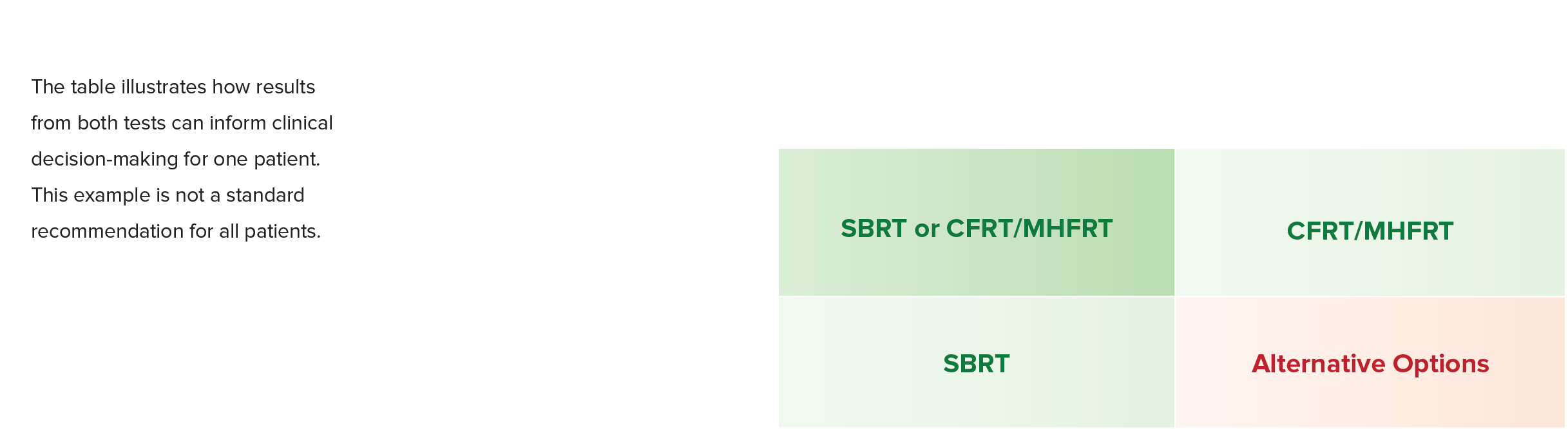
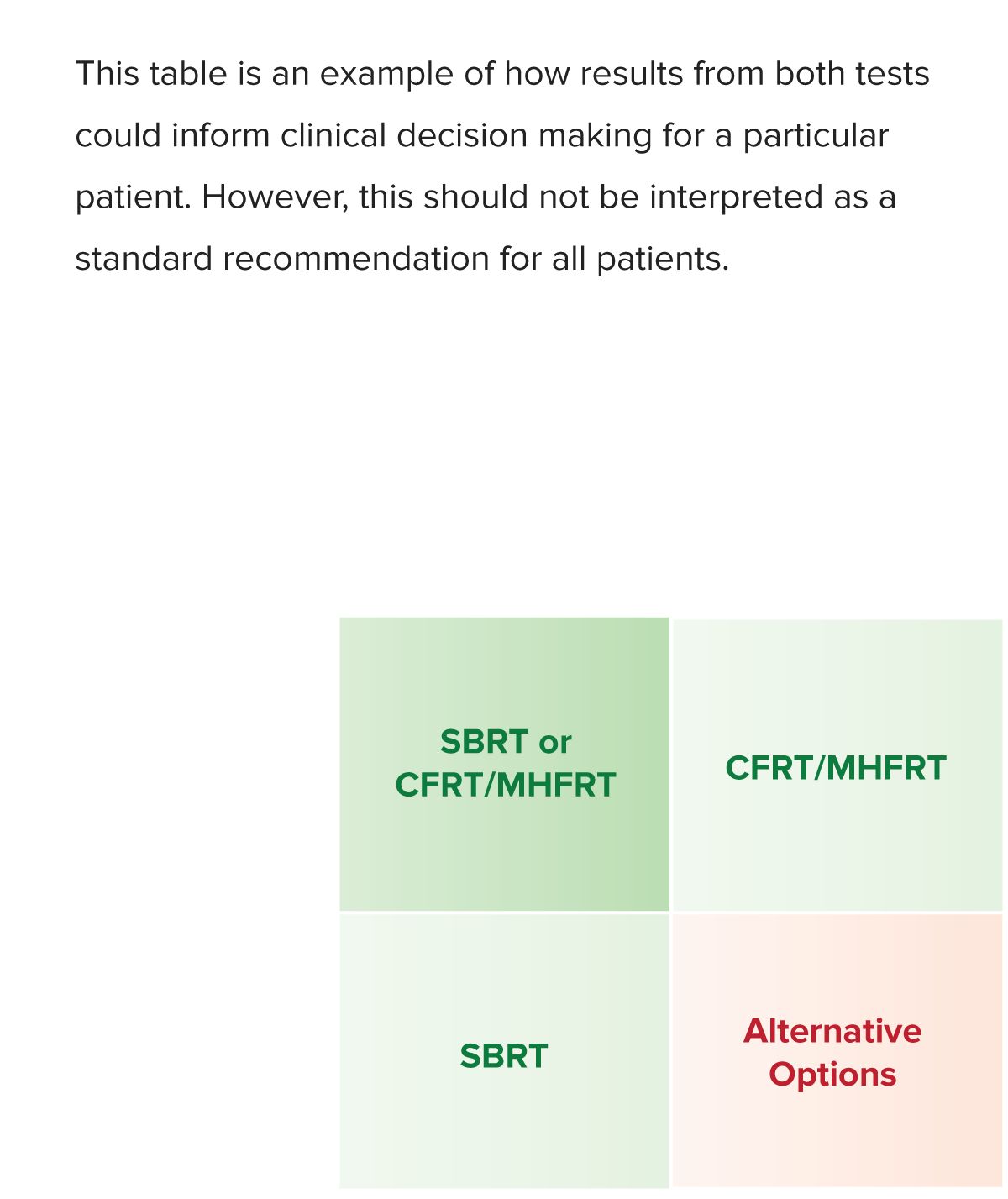
Most patients will be LOW-AVERAGE RISK to both treatments (78%), while some may be high risk to either SBRT (11%) or CFRT/MHFRT (10%). In rare cases, a patient may be at HIGH RISK for both (1-2%).3
When we initially discovered PROSTOX, the data were exciting, but a frequent question that arose is whether a test designed to predict toxicity following radiation delivered years ago would be applicable even in the context of ultra-modern, high-precision radiotherapy. Of course, if PROSTOX were truly a test of the biological response to radiation — which we believed was the case — then PROSTOX would be predictive in men treated on a contemporary trial. The validation of PROSTOX as a predictive biomarker in the MIRAGE trial cohort, which ran from 2020-2021, tells us that a genetic proclivity to increased toxicity after radiation persists even with modern, advanced SBRT, including MRI-guided SBRT. This substantiates that it is a true test of biology.”
Dr. Amar Kishan, MD, Radiation Oncologist
Executive Vice Chair for the Department of Radiation Oncology at the David Geffen School of Medicine at UCLA and the UCLA Jonsson Comprehensive Cancer Center

PROSTOX
References:
- Litwan, Mark S., Tan, Hung-Jui. The diagnosis and treatment of prostate cancer--a review. JAMA. 2017;317(24):2532-2542. doi:10.1001/jama.2017.7248.
- Tree AC, Ostler P, Voet H van der, et al. Intensity-modulated radiotherapy versus stereotactic body radiotherapy for prostate cancer (PACE-B): 2-year toxicity results from an open-label, randomised, phase 3, non-inferiority trial. Lancet Oncol. 2022;23(10):1308-1320. doi:https://doi.org/10.1016/S1470-2045(22)00517-4.
- Based on internal data from patients in clinical trials and real-world clinical settings.