
Evidence-Based Prediction of Late Genitourinary (GU) Radiation Toxicity with PROSTOX®
PROSTOX tests are clinically validated genetic tests that identify patients at increased risk for late radiation toxicity by analyzing inherited microRNA-associated genetic variants (mirSNPs). These variants affect pathways involved in DNA damage repair, inflammation, and cellular stress responses that are key biological drivers of individual radiation tolerance.
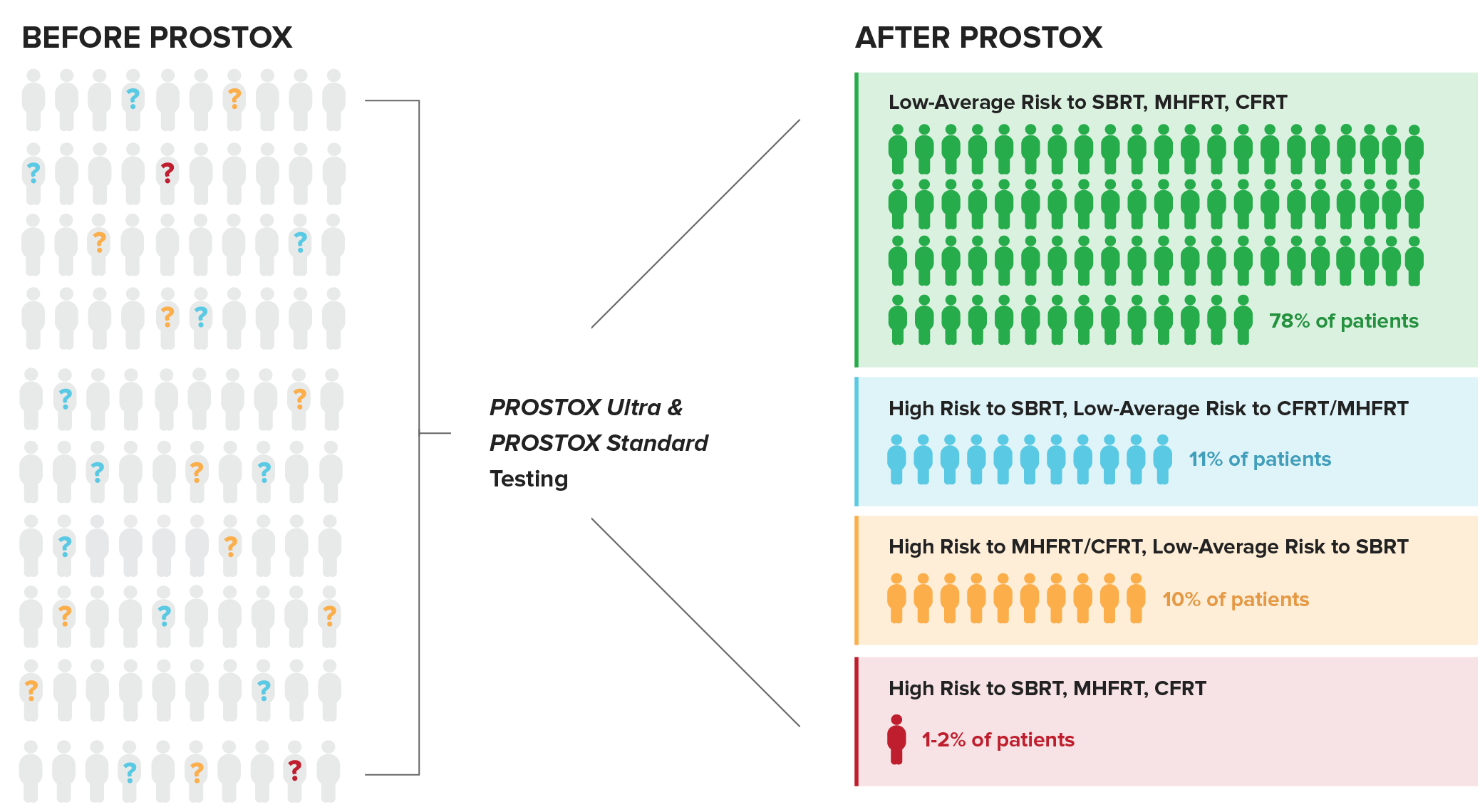
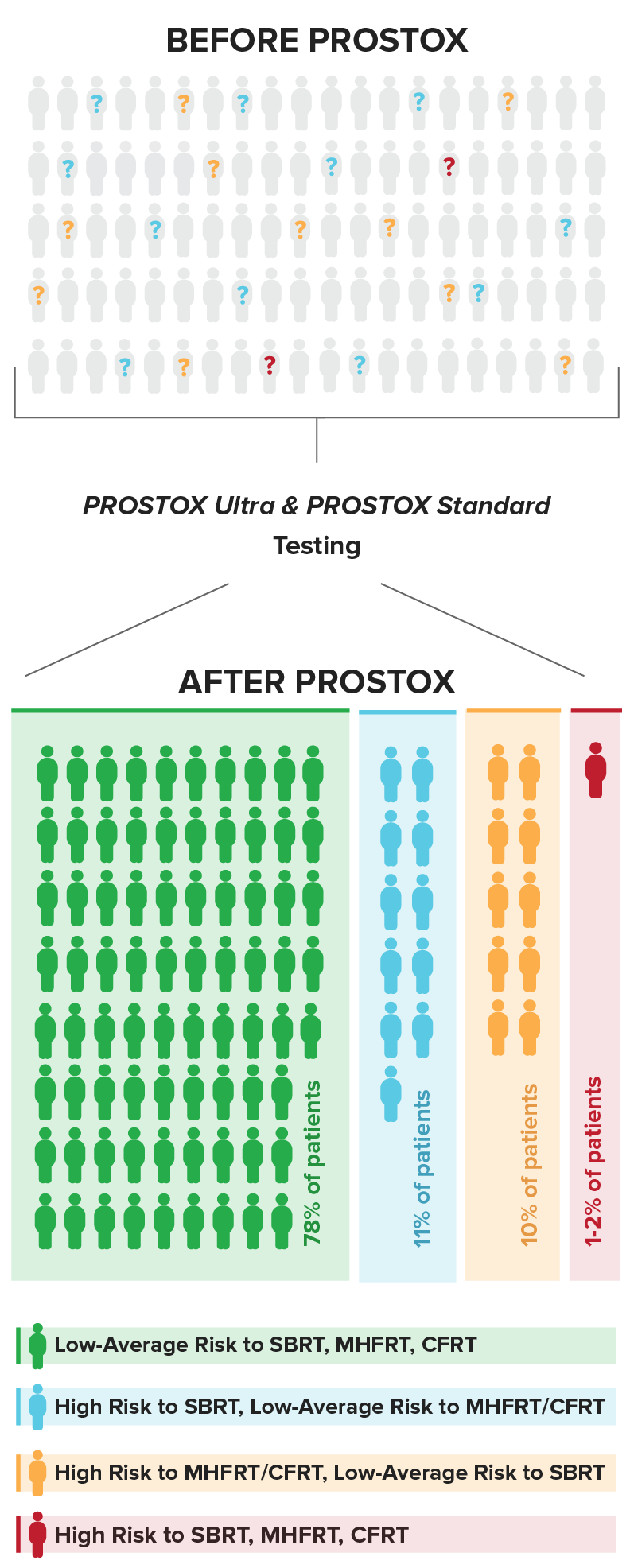
Based on internal data from patients in clinical trials and real-world clinical settings.
Patients identified as high risk have a ~75% probability of developing toxicity with the specified radiation regimen. This valuable insight enables clinicians to select the safest treatment strategy.
Discover Precision, Clarity, and Confidence
PROSTOX Test Performance1-3
PROSTOX Ultra
96%
NPV
Negative Predictive Value
77%
PPV
Positive Predictive Value
70%
SENSITIVITY
95%
SPECIFICITY
PROSTOX Standard
93%
NPV
Negative Predictive Value
75%
PPV
Positive Predictive Value
70%
SENSITIVITY
95%
SPECIFICITY
Proven Guidance
Supported by a growing body of peer-reviewed clinical evidence, PROSTOX tests provide an objective risk profile that complements traditional clinical factors and supports personalized treatment choices.
PROSTOX Ultra
Predicts late GU toxicity risk from SBRT in patients with localized prostate cancer.
PROSTOX Standard
Predicts late GU toxicity risk from CFRT/MHFRT in patients with localized prostate cancer.
Clinical evidence highlights
- High-risk patients have a significantly higher likelihood (~11 fold for PROSTOX Standard) of developing late radiation toxicity compared with low-average risk patients.2
- Late GU toxicity risk can be predicted independently of clinical or dosimetric variables.2,3
- Test results have been shown to guide both physician and patient treatment decisions.4
- PROSTOX Ultra is appropriate for use in patients undergoing post-prostatectomy SBRT.5
Evidence
Explore the research and learn how PROSTOX can impact your and your patients’ treatment selection.
2025 | Economic Evaluation
Economic Evaluation of a Novel MicroRNA-Based Assay to Determine Risk of Late Genitourinary Radiation Toxicity in Patients With Prostate Cancer
Health economic analysis
PROSTOX Ultra shows significant heatlh system cost savings and quality-of-life gains for prostate cancer patients undergoing radiaion therapy.
View2025 | PROSTOX Ultra high-risk study
Treatment Choices and Toxicity Outcomes in Patients with a High Risk PROSTOX Score
Prospective cohort study
Patients identified as genetically at high-risk for toxicity after SBRT do not appear to be at higher risk of toxicity after MHFRT or CFRT.
View2025 | Clinical Validation
PROSTOX, a signature of late GU toxicity after SBRT radiotherapy in MIRAGE, a prospective trial
Phase III, randomized clinical study
PROSTOX can accurately predict late Grade ≥ 2 GU toxicity after SBRT, regardless of treatment modality.
View2023 | Clinical Utility
The impact of a genetic signature of late radiation toxicity on prostate cancer treatment decision making
Phase II, single-center, prospective clinical study
PROSTOX predicts toxicity risk from SBRT or CFRT and influences treatment decisions for localized prostate cancer.
View2023 | POST-OP Clinical Validation
Application of a genetic signature of late GU toxicity in SCIMITAR, a Post-op SBRT trial
Phase II, dual-center, single-arm clinical study
PROSTOX identifies a higher risk for late grade ≥ 2 genitourinary (GU) toxicity following post-prostatectomy SBRT.
View2022 | Development Study
Germline variants disrupting microRNAs predict long-term GU toxicity after prostate cancer radiation
Developmental Study
Germline mirSNP-based predictive models effectively forecast late-grade ≥ 2 GU toxicity following CFRT or SBRT.
ViewPROSTOX
References:
-
- Based on internal data from patients in clinical trials and real-world clinical settings.
- Kishan AU, McGreevy K, Telesca D, Weidhaas JB. Treatment choices and toxicity outcomes in patients with a high-risk PROSTOX score. Int J Radiat Oncol Biol Phys. 2025;123(1):e615. doi:10.1016/j.ijrobp.2025.06.2894.
- Kishan AU, Marco N, Schulz-Jaavall MB, et al. Germline variants disrupting microRNAs predict long-term genitourinary toxicity after prostate cancer radiation. Radiother Oncol. Feb 2022;167:226-232. doi:10.1016/j.radonc.2021.12.040.
- Weidhaas JB, Marco N, Steinberg ML, et al. Early findings from the GARUDA trial: the impact of a genetic signature of late radiation toxicity on prostate cancer treatment decision making. J Clin Oncol. 2023;41(16_suppl):5089. doi:10.1200/JCO.2023.41.16_suppl.5089.
- Kishan AU, Marco N, Ma TM, et al. Application of a genetic signature of late GU toxicity in SCIMITAR, a Post-op SBRT trial. Clin Transl Radiat Oncol. 2023;39doi:10.1016/j.ctro.2023.100594.